
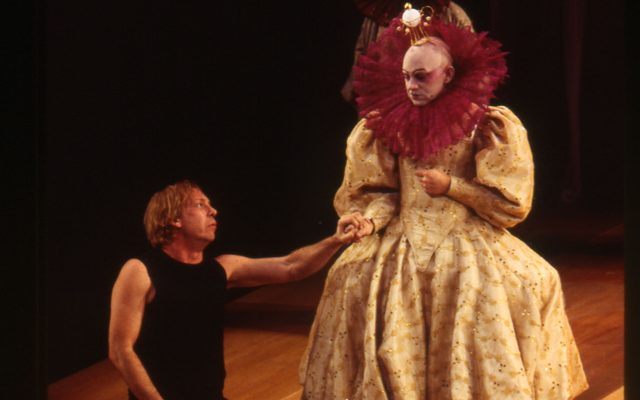
Richard, son of Edward the Black Prince, ascended the throne of England at the age of ten. An elegant, luxurious, sensitive monarch, “too favorable” to his enemies and oblivious to his people’s suffering, Richard is ultimately stripped of his wealth, power, and kingdom—and with them his sense of self. Innovative director Robert Woodruff returns to stage this most lyrical and psychologically complex of Shakespeare’s history plays.
SYNOPSIS
King Edward III of England had seven sons, among them the Duke of Gloucester, John of Gaunt, the Duke of York, and Edward the Black Prince. When Edward III died in 1377, his ten-year old grandson Richard, son of the Black Prince, succeeded him to the throne as King Richard II.
While Richard was a child, John of Gaunt and the Dukes of Gloucester and York effectively ruled the kingdom, but Richard soon asserted his independence from his uncles and chose his own advisors, including John Bushy, William Bagot, and Henry Green, to help him govern.
In 1397, shortly before Shakespeare’s play begins, the Duke of Gloucester is murdered, probably at Richard’s command. Gaunt’s son, Henry Bolingbroke, quarrels with Thomas Mowbray, Duke of Norfolk, over the cause of Gloucester’s death, and Richard banishes both men from England. The shock of his son’s exile weakens the elderly Gaunt, who soon dies. Richard seizes Gaunt’s property and belongings and sets out for Ireland where he hopes to raise further revenue to fund his extravagant lifestyle. But he reckons without Henry Bolingbroke, who, hearing of his father’s death, secretly returns from France to claim his birthright from Richard.
Photos & Videos


Credits
Creative team
By
William Shakespeare
Directed by
Robert Woodruff
Directed by
Robert Woodruff
A.R.T.: Artistic Director, 2002-07. Directed Britannicus, Orpheus X, Island of Slaves, Olly's Prison, Oedipus, Sound of a Voice, Highway Ulysses, Richard II, Full Circle (2000 Elliot Norton Award for Best Director) and In the Jungle of Cities (1998 Elliot Norton Award for Best Director). A.R.T./MXAT Institute: directed Charles L. Mee's Trojan Women A Love Story.
Robert Woodruff is one of the country's most versatile stage directors. His theatrical vocabulary encompasses a remarkable range of styles, from the naturalistic simplicity of his productions of Shepard and Bond to his baroque deconstructions of Shakespeare and Brecht. Woodruff collaborates with living playwrights and revisits the masterpieces of the classical canon with equal flair. His body of work resists categorization, and is united only by the power of his imagination and the rigor that he demands of his actors and designers. After thirty years of directing, Woodruff continues to develop fresh dramatic forms with each production.
Woodruff was born in Brooklyn in 1947 and spent his childhood on Long Island. After gaining a B.A. in political science at the University of Buffalo he began graduate studies at the City College of New York. In 1971, disenchanted with the reactionary New York theatre establishment, he moved to San Francisco to seek out new writers and artistic collaborators. The following year he co-founded the Eureka Theatre, where he served as Artistic and Resident Director until 1978.
In 1976 Woodruff established his second theatre, the Bay Area Playwrights Festival, a summer forum for the development of new plays that is still flourishing. It was here that Woodruff first worked with the writer Sam Shepard, on a libretto that Shepard had developed for the national bicentennial celebrations, The Sad Lament of Pecos Bill. The thirty-three year-old playwright was still better known in London than the States, and his collaborations with Woodruff marked a turning point in both men's careers. For the next five years Woodruff was virtually the sole director of Shepard's work, staging the American premiere of Curse of the Starving Class at the New York Shakespeare Festival in 1978, the world premieres of Buried Child (1978) and True West (1980) in San Francisco and New York, and the touring productions of Tongues and Savage/Love, which Shepard co-authored with the performer Joseph Chaikin.
While staging Shepard's naturalistic family dramas, Woodruff developed an unadorned directorial style that emphasized textual precision and subtlety of performance over elaborate stagecraft. From time to time he still draws on this minimalist form, in his recent New York revival of Edward Bond's Saved, for example, and in domestic interludes in Richard II, Full Circle, and In the Jungle of Cities, where time slows almost to a halt, and the most mundane details take on poetic significance.
In 1983 Woodruff staged The Comedy of Errors with the The Flying Karamazov Brothers at the Goodman Theatre in Chicago and at Lincoln Center in New York City. The production was the first in which Woodruff's directorial hand was immediately visible, and audiences were astonished to find fire-eaters, acrobats, and jugglers delivering Shakespeare's language. His formal experimentation continued with a series of major productions at the La Jolla Playhouse in California, and other regional houses including the Mark Taper Forum, the Guthrie Theatre, and the American Conservatory Theatre. Although he continued to stage new plays, he developed a reputation as one of a handful of progressive directors who enjoy working with classic texts from every period.
At La Jolla, Woodruff's productions included radical deconstructions of The Tempest, Happy Days, and Man's a Man, the first part of his cycle of Brecht's early plays that continued with Baal (1990) at Trinity Repertory Company, and In the Jungle of Cities (1998) at A.R.T. Woodruff is particularly adept at unpacking the visceral poetry of Brecht's sprawling epics. Writing in the Boston Globe, Kevin Kelly described Baal as "fiery onslaught. It burns right in front of you, scorches everything it touches, and draws you into the roar of its out-of-control furnace. It may be the single most brilliant Brecht I've ever seen."
Woodruff's investigation of the classics continued with Julius Caesar, The Duchess of Malfi, Medea, and The Changeling. The latter two he staged in Israel, where he has established a considerable body of work. Although these revivals were stylistically very different from each other, they all challenged conventional notions of scale and design. Woodruff frequently avoids a unified aesthetic style in his productions, preferring to create startling visual and aural juxtapositions that shed new light on canonical texts. "Unity is overrated," he once said. "Defining a whole and making all its pieces correspond to that oneness can lead to a stifling politeness. I'd rather take each moment and make it burn, make that color very bright."
One of Woodruff's greatest strengths as a director is his ability to collaborate. Whether staging the first production of a new play or reviving a classical masterpiece, his writers, actors, and designers work with him as equals. He has built firm relationships with some of the world's finest playwrights, performers, and artists, including the scenic designers Douglas Stein and George Tsypin, who have contributed much to Woodruff's visual style. Although he has a strong aesthetic vision, Woodruff allows his collaborators an unusual latitude in shaping each production. "I don't try to control, I try to encourage," he once told an interviewer. "There's something I like about avoiding agreements. Obviously the set designer and the costume designer have to talk about color, but I would almost like to have them separate, to make their own statement. If everybody responds to the material in a way that's true to them, what emerges is the resonance of all those voices rather than the agreement of all those voices. It has to be more interesting."
In recent years, one of Woodruff's chief collaborators has been the playwright Charles L. Mee, who shares his taste for collage composition. Woodruff's A.R.T. production of Mee's Full Circle was a fine example of the director's mature style - a patchwork of dramatic forms that continuously subverted the audience's expectations, forcing them into a new encounter with apparently familiar material, and providing an ironic commentary on Mee's text and the political eruption that it dramatizes. As Full Circle admirably demonstrated, although Woodruff's reputation is as a director of intensely introspective tragedies, he is equally at home in a world of dazzling vaudeville.
Although he lives in New York, Woodruff seldom directs there, preferring the more generous schedules of the larger regional theatres. "You can't do The Comedy of Errors with nineteen vaudevillians in Manhattan," he once said. Since 1997 he has taught directing and acting as Assistant Professor at Columbia University, and has earned a reputation as one of the nation's most committed and popular mentors. In 1983 he told Scott Cummings, then a student at the Yale School of Drama, that one of his greatest regrets about theatre in the States was the lack of formal apprenticeship. "As a director that's very difficult," he said, "because of the responsibility you assume with your role. Directing is by its very nature a master craft. It takes years." Eighteen years later, Robert Woodruff has become one of the undisputed master-craftsmen of the American theatre. It is a great privilege that he has agreed to make A.R.T. his artistic home, and we are thrilled to participate in the next chapter of his remarkable career.
Set design by
David R. Gammons
Set design by
David R. Gammons
David R. Gammons (set designer, Richard II) is a director, designer, and visual artist. Other designs for the American Repertory Theater include Becket Trio: Eh Joe, Ghost Trio, and Nacht und Tråume (which toured to Strasburg, France) and Spencer/Colton's Winter Circus. Mr. Gammons is a graduate of the directing program at the American Repertory Theater/Moscow Art Theater Institute for Advanced Theater Training at Harvard University, where he directed productions of The Balcony, Twelfth Night, and Edward II, and designed sets and costumes for The Cure at Troy, Best Intentions, and St. Joan of the Stockyards, among many others. He is the founder and artistic coordinator of no more masterpieces, a performance collective dedicated to generating original dance/theater work, and conceived and directed their premiere productions Spanking the Maid, A Crying of Bones, and Heaven's Sake. He is currently the director of the theater program at Concord Academy.
Costume design by
Catherine Zuber
Costume design by
Catherine Zuber
Catherine Zuber has created the costumes for Richard II, The Doctor's Dilemma, and over forty other A.R.T. productions including Three Farces and a Funeral, Antigone, Loot, The Idiots Karamazov, Ivanov, Phaedra, The Merchant of Venice, Valparaiso, The Imaginary Invalid, The Taming of the Shrew, Peter Pan and Wendy, The Bacchae, Man and Superman, The Cabinet of Doctor Caligari, Woyzeck, The Wild Duck, The Naked Eye, Long Day's Journey Into Night, Tartuffe, Ubu Rock, Waiting for Godot, The Oresteia, Shlemiel the First, Picasso at the Lapin Agile, A Touch of the Poet, What the Butler Saw, The Cherry Orchard, and Orphée. Ms. Zuber's credits include work at Lincoln Center, The Joseph Papp Public Theater, Goodman Theatre, The Guthrie Theater, Mark Taper Forum, Seattle Repertory Theatre, Hartford Stage Company, La Jolla Playhouse, Berkeley Repertory Theatre, Houston Grand Opera, and Glimmerglass Opera, among others. Her Broadway credits include The Triumph of Love (Connecticut Critics Circle Award and Drama Desk nomination), Ivanov (Drama Desk nomination), The Sound of Music, Twelfth Night, The Red Shoes, London Assurance, The Rose Tattoo, and Philadelphia Here I Come. Ms. Zuber was the recipient of the 1997 Obie Award for sustained achievement in design. She is the costume designer for La Fête des Vignerons de 1999, the massive Festival of the Winegrowers in Vevey, Switzerland.
Lighting design by
Steven Strawbridge
Lighting design by
Steven Strawbridge
Stephen Strawbridge (lighting designer, Richard II) has designed over one hundred plays, operas, and dance/theater works on Broadway, Off-Broadway, at regional theaters across the country, and internationally. Recent work includes La Boheme, Ariodante, and Orfeo ed Euridice for New York City Opera and Glimmerglass Opera; Rigoletto for the Dallas Opera; School for Scandal and A Christmas Carol for the McCarther Theatre; and Cosi fan Tutte for Houston Grand Opera; as well as Ahab's Wife for Spencer/Colton Dance; Martha Clarke's An Uncertain Hour for Lincoln Center and the Netherlands Dance Theatre; and Robert Wilson's Hamlet, A Monologue, at Lincoln Center and the Alley Theatre in Houston. Mr. Strawbridge is an associate professor of design and co-chair of the Design Department at the Yale School of Drama.
Sound design by
Darron L West
Sound design by
Darron L West
A.R.T.: The Tempest, bobrauchenbergamerica, La Dispute, Richard II, Punch and Judy Get Divorced. Darron is a TONY and OBIE award-winning sound designer whose 33-year career spans theater and dance, Broadway, and Off-Broadway. His work has been heard in over 650 productions all over the United States and internationally in 15 countries. Additional honors include the Drama Desk, Lortel, Audelco and Princess Grace Foundation Statue Awards among many others. His soundscapes for Photograph 51, Paradise Blue, and Coal Country can be heard on Audible.
| King Richard II | Thomas Derrah |
| Young Man | Jonno Roberts |
| Duke of Gloucester (Richard’s uncle) | John Feltch |
| John of Gaunt (Duke of Lancaster, Richard’s uncle) | Alvin Epstein |
| Dutchess of Gloucester | Karen MacDonald |
| Queen to Richard | Jodi Lin |
| Richard’s attendant | Darrin Browne |
| Bishop of Carlisle | Remo Airaldi |
| Thomas Mowbray (Duke of Norfolk) | Benjamin Evett |
| Henry Bowlingbroke (Duke of Hereford, Gaunt’s son) | Bill Camp |
| Aumerle (York’s son) | Sean Dugan |
| Bagot (one of Richard’s favorites) | Trevor Oswalt |
| Greene (one of Richard’s favorites) | Jim Spencer |
| Bushy (one of Richard’s favorites) | Tim Kang |
| Duke of York (Richard’s uncle) | John Douglas Thompson |
| Earl of Northumberland (Bolingbroke’s supporter) | John Feltch |
| Lord Ross (Bolingbroke’s supporter) | Robert Ross |
| Lord Willoughby (Bolingbroke’s supporter) | Jonno Roberts |
| Sir Stephen Scroope | Benjamin Evett |
| Dutchess of York | Karen MacDonald |
| Sir Piers Exton | Tim Kang |
| Prison Keeper | Jim Spencer |
| Ensemble | Jason Beaubier, James Dittami, Seth Reich, Kieran Smiley, Chris Starr, and members of the company |